What Bali's Ancient Rice Farmers Can Teach Your Backyard Garden
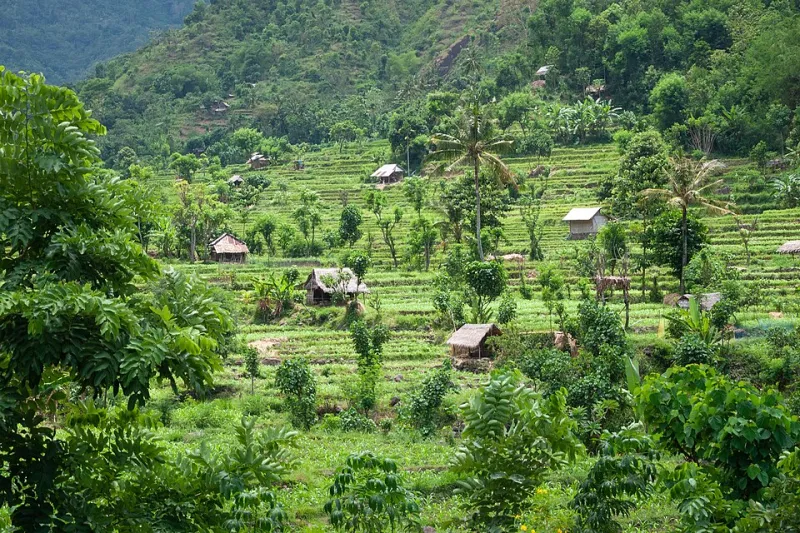
Photo: Vyacheslav Argenberg, CC BY 4.0, via Wikimedia Commons
There's a moment, if you've ever stood at the edge of Bali's Tegallalang rice terraces, where the sheer logic of the landscape just hits you. Every terrace feeds water to the one below it. Every crop seems to belong exactly where it's planted. Nothing looks wasted. Nothing looks stressed. It's agriculture as a kind of choreography — and it's been running smoothly for roughly a thousand years.
That system has a name: Subak. And while you probably don't have a terraced hillside behind your house in suburban Ohio, the principles underneath Subak are turning out to be surprisingly portable.
What Subak Actually Is (And Isn't)
Subak is often described as a traditional irrigation system, and that's technically accurate — but it undersells the thing considerably. Recognized by UNESCO as a Cultural Landscape in 2012, Subak is really a community-governed approach to land and water management, one that weaves together farming, spirituality, and collective decision-making in a way that Western agricultural models rarely attempt.
At its core, Subak coordinates water flow across interconnected rice paddies through a network of canals, tunnels, and weirs managed by a community water temple. Farmers don't just grow their own plots in isolation — they synchronize planting and fallow cycles across the whole system, which naturally disrupts pest populations, prevents soil depletion, and keeps water distribution equitable.
Polyculture — growing multiple crops together rather than one crop in rows — is baked into the method. Balinese farmers have long intercropped rice with vegetables, legumes, and herbs, allowing different root systems and canopy heights to support each other in ways that monoculture simply can't replicate.
"What struck me most when I started researching Subak wasn't the irrigation engineering," says Dana Whitfield, an organic market gardener based outside Asheville, North Carolina, who spent three weeks in Bali studying traditional farming practices in 2022. "It was the community piece. Decisions about what gets planted when, and where the water goes — those happen collectively. That's almost the opposite of how most American gardeners think about their plots."
American Gardeners Are Paying Attention
Whitfield isn't alone. Across the US, a growing number of home gardeners and small-scale organic farmers are experimenting with polyculture and companion planting strategies that echo Balinese methods — even if they didn't start out thinking of it that way.
In Portland, Oregon, Marcus Tran converted his 1,200-square-foot backyard into a layered growing system after a frustrating run of pest problems with his tomatoes. "I kept losing whole sections to aphids and hornworms," he says. "A friend suggested interplanting with basil, marigolds, and nasturtiums — which I later found out is pretty close to what Balinese farmers do with their vegetable plots. The difference in my garden that first season was honestly kind of shocking."
The science behind these outcomes is increasingly well-documented. Polyculture systems reduce pest pressure by disrupting the visual and chemical cues insects use to locate host plants. Deep-rooted plants like daikon radish break up compacted soil, benefiting shallower-rooted neighbors. Nitrogen-fixing legumes — beans, peas, clover — quietly replenish what heavy feeders like corn or squash pull out.
These aren't new discoveries. Balinese farmers figured them out empirically over centuries. What's new is that American gardeners are reaching back toward that knowledge after decades of being sold on the idea that synthetic inputs and monoculture rows were the efficient, modern way to grow food.
The Fallow Cycle: The Part Most Gardeners Skip
One of the most important — and most overlooked — elements of Subak-inspired growing is the intentional fallow period. In Bali, coordinated fallow cycles across a Subak system do something remarkable: they starve out pests that depend on a continuous crop host. When every farmer in a water temple district rests their paddies at the same time, the local population of rice brown planthoppers collapses.
Most American home gardeners don't have neighbors coordinating fallows with them, but the principle still applies at the plot level. Rotating which beds lie fallow — even for a single season — and covering them with a nitrogen-fixing cover crop like crimson clover or hairy vetch gives soil biology time to recover and rebalance.
Priya Nair, who runs a one-acre organic market garden in Sonoma County, California, started incorporating intentional fallow rotation three years ago after reading about Subak water temple coordination. "I can't synchronize with my neighbors the way a Balinese Subak does," she laughs. "But I can rest a third of my beds every season and plant them with cover crops. My soil organic matter has gone up measurably, and I'm using a lot less compost to compensate for depletion."
A Practical Starting Point for Your Own Garden
You don't need to redesign your entire yard to start pulling from these ideas. Here's a simple framework inspired by Subak principles that works even in small urban and suburban garden spaces:
1. Think in guilds, not rows. Group plants by what they give and take from the soil. A classic Balinese-inspired guild might pair a climbing bean (nitrogen fixer) with a sprawling squash (ground cover, moisture retention) and a tall corn stalk (trellis). The "Three Sisters" planting method that many Native American agricultural traditions also use is a close cousin to this logic.
2. Layer your canopy. Tall plants shade the soil and protect shorter, moisture-loving crops. Incorporate at least three height levels in any bed: tall (corn, sunflowers, staked tomatoes), medium (peppers, eggplant, herbs), and low (lettuce, strawberries, ground-cover herbs like thyme).
3. Let something flower. Balinese polyculture almost always includes flowering plants alongside edibles — both for spiritual reasons and for the practical benefit of attracting pollinators and beneficial predatory insects. Marigolds, borage, and sweet alyssum are easy additions that do real work in a mixed bed.
4. Rest and replenish. Plan at least one bed per season to lie fallow under a cover crop. Crimson clover, buckwheat, and winter rye are all widely available and easy to manage. Chop and drop them before they go to seed and they'll add organic matter right back into your soil.
5. Water from the top of the system down. If your yard has any slope at all, position water-intensive crops uphill and let gravity assist drainage toward drought-tolerant plants lower down. It's a simplified echo of Subak's gravity-fed canal logic, but it genuinely reduces watering labor.
Growing Food as a Community Practice
Maybe the deepest takeaway from Subak isn't any specific planting technique — it's the underlying philosophy that growing food works better as a shared, relational practice than as an isolated individual pursuit.
More American gardeners are finding their way back to that idea through neighborhood seed swaps, community composting programs, and informal plot-sharing arrangements. It's a small echo of what Bali's water temples have been doing for a millennium: making agriculture a conversation rather than a transaction.
Your backyard may not have a UNESCO designation. But the soil under it is capable of a lot more than we've been giving it credit for — especially when we stop trying to control it and start trying to work with it instead.
Inspired by the agricultural wisdom behind the flavors we celebrate at Ubud Organic Market. Explore our sourcing philosophy at ubudorganicmarket.org.