Cassava Over Quinoa: Why the Balinese Approach to Everyday Crops Is Quietly Winning
Somewhere between the açaí bowl craze and the moringa powder moment, a lot of American eaters started feeling exhausted. The wellness industry had turned nutrition into a rotating door of expensive imports, each one promising to be the food that finally fixed everything. And every few months, the answer changed.
In Bali, that conversation was never happening.
Balinese agricultural philosophy doesn't have a superfood category. What it has instead is something far more practical and, honestly, more radical: a deep, generational commitment to growing and eating whatever the land does best, prepared with enough skill and intention that no exotic import could ever compete.
American home gardeners and conscious eaters are starting to pay attention.
The Hype Cycle Nobody Needed
Let's be honest about what the superfood industrial complex actually sold us. It sold convenience — the idea that you could sidestep the hard work of eating well by adding one powerful ingredient to your smoothie. It sold scarcity, too, because a food that grows in your backyard doesn't command a $28 price tag at the co-op.
The problem is that nutrition science has never really supported the superfood framework. Whole dietary patterns — not isolated compounds — are what drive long-term health outcomes. And Balinese food culture has understood this intuitively for a very long time.
In the villages around Ubud, the foods that appear on the table every single day aren't there because they went viral. They're there because generations of farmers learned, through careful observation and hard experience, that these crops sustained people through dry seasons, through labor-intensive harvest cycles, through everything life threw at them. Cassava. Sweet potato. Kangkung, the water spinach that grows along irrigation ditches. Jackfruit. Banana blossom. Tempeh made from local soybeans.
None of these foods need a marketing budget. They need good soil and someone who knows how to cook them.
What Balinese Farmers Actually Grow — and Why
The Balinese approach to crop selection is rooted in something called tri hita karana — a philosophical framework that emphasizes harmony between people, nature, and the spiritual world. In practical agricultural terms, this translates into a preference for crops that give back to the land, that don't require intensive chemical inputs, and that produce reliable nutrition across multiple harvests.
Cassava is a perfect example. It's drought-tolerant, grows in marginal soils, produces edible leaves and roots, and delivers a meaningful combination of carbohydrates, fiber, and — when the leaves are prepared correctly — protein and micronutrients including folate and vitamin K. In Bali, nothing about this plant gets wasted. The leaves become lawar or are cooked down into savory side dishes. The roots are boiled, fermented, or fried.
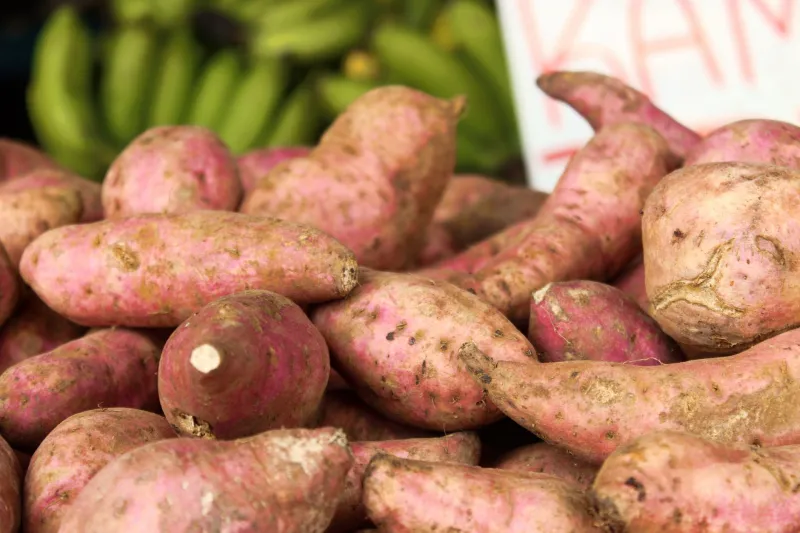
Sweet potato tells a similar story. Rich in beta-carotene, potassium, and complex carbohydrates, it's one of the most nutrient-dense foods per acre that any small-scale farmer can grow. In Balinese home gardens — the pekarangan tradition of layered, productive kitchen gardens — sweet potato vines often do double duty as ground cover while they produce food.
Compare the growing footprint and cost of these crops to, say, goji berries shipped from China or maca powder sourced from the Peruvian Andes, and the math stops making sense almost immediately.
American Gardeners Are Doing the Math
Across the US, a growing number of home growers are quietly abandoning the supplement aisle logic and applying something closer to the Balinese model to their own plots. In community gardens from Portland to Pittsburgh, people are asking a different question: not what's the most powerful food I can buy, but what grows here, what feeds my family well, and what can I actually sustain year after year?
For many of them, the answer looks a lot like what Balinese farmers have been growing all along.
Cassava is now cultivated in USDA hardiness zones 8 through 11 with real success — that covers a significant swath of the American South and West Coast. Sweet potato has always been a Southern staple, though it's increasingly showing up in Northern market gardens as growers experiment with shorter-season varieties. Water spinach, technically regulated in some states due to invasive species concerns, has legal cultivation pathways in many regions and is gaining traction among Southeast Asian-American home cooks who've known about it for decades.
Local greens — amaranth, purslane, dandelion, lambsquarters — are getting a second look too. These are plants that grow freely in American soils, require almost no inputs, and deliver nutritional profiles that rival anything in the specialty supplement section. Purslane, for instance, is one of the few plant sources of omega-3 fatty acids. It's also a weed that most people spray.
Growing with Intention Changes Everything
Here's what the Balinese model gets right that the superfood economy gets wrong: the relationship between grower and crop matters enormously for nutritional outcomes.
Research increasingly supports what traditional agricultural communities have practiced empirically — that soil health directly influences the micronutrient density of the food grown in it. Crops grown in living, biologically active soil with organic matter and beneficial microbial communities produce measurably more nutritious food than those grown in depleted, chemically managed ground.
Balinese farmers have composted, mulched, and maintained soil fertility through traditional practices for generations. The subak irrigation cooperatives that manage water flow through rice terraces also manage organic inputs and crop rotation in ways that keep the land productive without exhausting it.
When American gardeners grow cassava or sweet potato in genuinely healthy soil — amended with compost, managed without synthetic inputs, planted with companion crops — they're not just growing food. They're participating in a system that produces better nutrition and builds long-term land resilience at the same time.
The Anti-Hype Pantry
So what does a Balinese-inspired, anti-superfood pantry actually look like for an American household?
It starts with whatever grows well in your specific region. If you're in the Southeast, that might mean sweet potato, black-eyed peas, okra, and collard greens — all deeply nutritious, all historically undervalued because they've never had a wellness brand behind them. In the Southwest, tepary beans, amaranth, and chiles fit the same profile. In the Pacific Northwest, nettles, kale, and dried beans carry the load.
The point isn't to replicate Balinese cuisine. It's to replicate the Balinese logic — grow what your land does well, eat it consistently, prepare it with enough skill that it becomes genuinely satisfying, and stop chasing the next import that some Instagram algorithm decided was magical.
The humble staple crop has always been winning. We just stopped looking at it long enough to notice.