Same-Day Food: What Ubud's Market Culture Can Actually Teach American Neighborhoods
If you've ever been to the Ubud morning market before sunrise, you already know that the whole experience operates on a different clock than anything most Americans have encountered at a grocery store. Farmers arrive in the dark. Produce changes hands before dawn. By 8 a.m., a significant portion of what was harvested that morning is already being cooked somewhere. The supply chain, if you can even call it that, is measured in hours.
For most American food systems, that kind of speed sounds like a logistical fantasy. We've built our grocery infrastructure around the opposite model — centralized distribution, long transit times, extended shelf life achieved through cold storage and sometimes a lot of chemistry. The result is food that's technically available year-round but often picked days or weeks before it reaches a kitchen.
A growing number of farmers' market networks, CSA programs, and urban agriculture projects across the US are trying to invert that model. And many of them, whether they know it explicitly or not, are building something that looks a lot like what Ubud has been doing for centuries.
How Ubud's Food Ecosystem Actually Works
The Ubud model isn't a policy initiative or a food systems grant project. It emerged organically from the intersection of Balinese agricultural tradition, dense local farming communities, and a cultural expectation that food should be fresh — not as a premium, but as a baseline.
Most of the produce sold at Ubud's Pasar Pagi (morning market) comes from family farms within a short radius of town. Farmers cultivate small plots intensively, often using traditional Balinese companion planting and the water management principles of the subak system. Because the farms are close, because the supply chain is short, and because the market culture expects daily restocking, the food genuinely turns over fast.
There's almost no packaging. There's very little refrigeration. Food that doesn't sell gets composted or fed to animals. Waste is low not because of a sustainability campaign but because the whole system is calibrated around moving fresh product quickly.
The consumer side of this equation matters just as much. Balinese home cooks — and the warung owners who feed much of Ubud's working population — shop frequently and cook what they buy the same day. There's no concept of buying a week's worth of produce and hoping it holds. The market exists because people show up every morning, and people show up every morning because the market exists.
What American Organizers Are Building
Talk to farmers' market organizers in cities like Asheville, North Carolina, or Madison, Wisconsin, or Richmond, Virginia, and you'll hear a consistent frustration: the standard Saturday-morning market model, while beloved, doesn't actually replicate the daily rhythm that makes hyper-local food systems work.
Once-a-week markets put pressure on farmers to harvest for shelf life rather than peak ripeness. They create a boom-bust dynamic where unsold product becomes a loss rather than a resource. And they don't build the kind of habitual, daily relationship between producers and eaters that sustains a genuinely local food economy.
Some organizations are experimenting with solutions that echo the Ubud approach more closely.
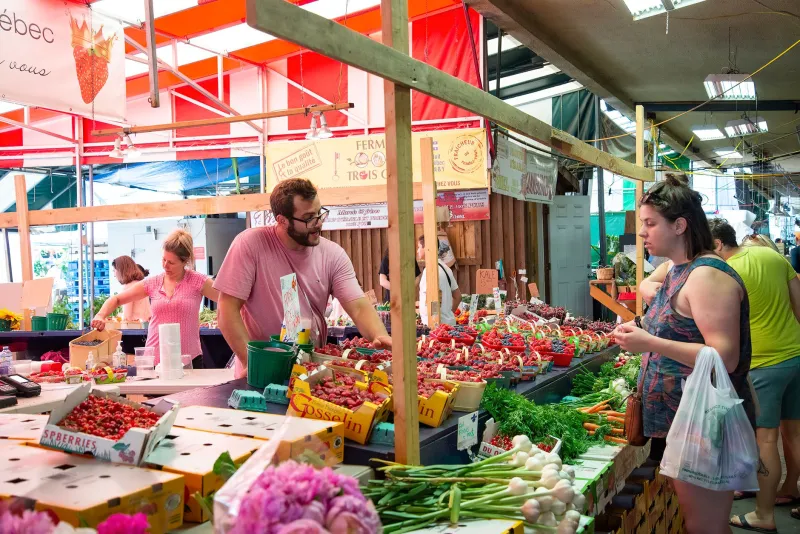
In several mid-sized American cities, mid-week satellite markets have launched as supplements to the main weekend event — smaller, faster, focused on whatever was harvested in the last 48 hours. Some farms are running their own farm stands with daily or near-daily hours, cutting out the market infrastructure entirely and selling direct from a roadside table or barn entrance.
CSA programs are evolving, too. Traditional CSA shares are typically packed once a week from produce harvested over a multi-day window. But a newer generation of CSA operators is experimenting with what some call "rapid-cycle" shares — smaller, more frequent deliveries timed to harvest schedules rather than administrative convenience. The produce is more perishable, but it's also dramatically more flavorful, and members who've experienced both models rarely want to go back.
The Technology Gap — and How Some Groups Are Closing It
One reason the Ubud model works is social density. Farmers and buyers know each other. Information about what's available moves through community channels — a text message, a conversation at the temple, word of mouth between neighbors. That informal communication infrastructure keeps the market responsive in a way that no app has quite replicated.
American farmers' market networks are trying to build digital equivalents. Several regional food hubs now operate online pre-order platforms that let farmers post what they'll have available 24 to 48 hours before pickup — not a week in advance, not based on a standardized share box, but based on what's actually ready to harvest right now. Customers browse, order, and pick up. Farmers harvest to order rather than speculating about demand.
It's not a perfect analog to the Ubud morning market. But it closes some of the same gaps: it reduces waste, it gets food moving faster, and it starts to build the habitual relationship between producer and consumer that makes local food systems resilient.
Urban agriculture projects are adding another layer. Rooftop farms, vacant lot gardens, and school-based growing programs in cities like Detroit, Baltimore, and Los Angeles are creating hyper-local supply points that can realistically operate on a daily or near-daily cycle because the growing site is already embedded in the neighborhood. When your food is grown three blocks away, a 24-hour field-to-table window stops being aspirational and starts being achievable.
What Has to Change for This to Scale
Honestly? Habits, more than infrastructure.
The Ubud market model works because Balinese home cooks are oriented around daily shopping and same-day cooking. That rhythm is cultural — it's built into how people plan their time, how they think about meal preparation, what they expect food to taste like. Replicating the supply-chain mechanics without shifting the consumer behavior only gets you halfway there.
American households that have made the shift — families who've joined rapid-cycle CSAs, who shop at mid-week markets, who've built a relationship with a specific farm and check in on what's available before they plan their meals — consistently report that the food tastes better and that they waste significantly less. The planning logic inverts: instead of deciding what you want to eat and then shopping for ingredients, you find out what's freshest and build your meals around that.
That's exactly how a Balinese grandmother approaches the Pasar Pagi. She doesn't arrive with a recipe in mind. She arrives to see what the morning brought, and then she cooks accordingly.
There's a version of that available in most American cities right now, if you know where to look. The networks building it are doing some of the most important food systems work happening in this country — and they're doing it one harvest cycle at a time.