Sold Out by Noon: What Balinese Markets Understand About Food That American Grocery Stores Never Will
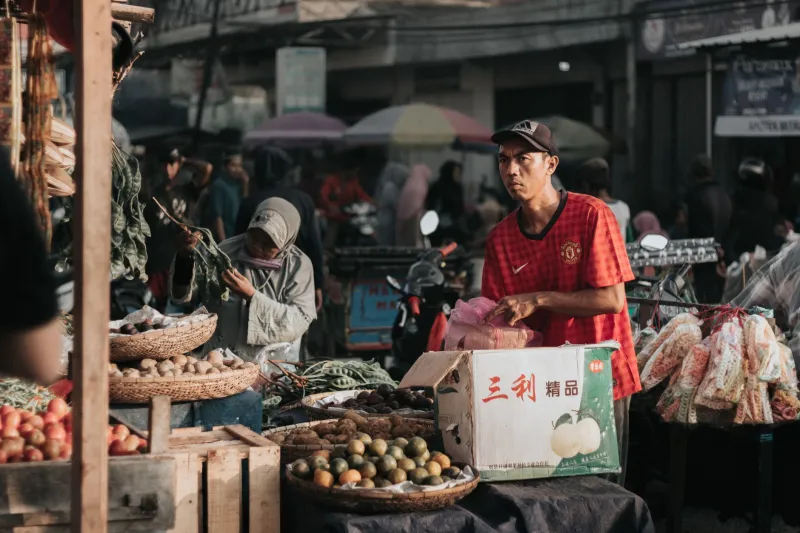
Somewhere in Ubud, right now, a vendor is packing up her woven baskets. The banana leaves are gone. The pile of snake beans she harvested before sunrise has been reduced to a few stragglers. Her tempeh—still warm from the fermentation process that finished overnight—sold out an hour ago. It's 10 a.m., and she's heading home.
This is not a failure of supply. It's the system working exactly as intended.
Balinese morning markets operate on a logic that is almost incomprehensible to the American grocery shopper conditioned to expect 47 varieties of yogurt available at 2 a.m. The market opens at dawn because that's when food is freshest. It closes before noon because if it hasn't sold by then, it probably shouldn't be sold. There is no markdown sticker. There is no "manager's special" shelf. There is just food, moving fast, from hands that grew it to hands that will cook it within the hour.
I want to make an argument that this model—inconvenient, unscalable, and completely at odds with American consumer expectations—is actually closer to what a healthy food culture looks like. And that our obsession with abundance and access has cost us more than we've admitted.
The Abundance Trap
American grocery stores are engineered to make you feel like you're never in danger of going without. The produce section glows under fluorescent lights, stacked high with apples from New Zealand, tomatoes from Mexico in January, and strawberries that taste like the color red but nothing else. It's impressive. It's also a kind of lie.
That abundance requires an extraordinary infrastructure of cold chain logistics, post-harvest chemical treatments, and long-distance transport that systematically prioritizes durability over flavor and shelf life over nutrition. A tomato bred to survive a 1,500-mile truck ride is a different biological object than a tomato that traveled twelve miles from a farm this morning. They share a name. They do not share much else.
Balinese markets don't have the infrastructure—or the incentive—to maintain that illusion. What's there is what's in season. What's in season is what's at its peak. And because the window to sell it is short, nothing lingers long enough to pretend it's something it's not.
Scarcity Creates Community
Here's the thing about a market that closes at noon: it gives everyone a reason to show up at the same time.
The Balinese morning market is one of the most socially dense environments in the village. Neighbors negotiate over the last bunch of water spinach. Vendors know their regulars by name, by preference, by family situation. A grandmother buying chilies will get a recommendation about what's particularly good today, passed along with the kind of casual authority that comes from someone who has been selling at the same spot for twenty years.
This isn't nostalgia. It's social infrastructure. The market is a daily ritual of community maintenance, and the time pressure—get there before it's gone—is what pulls everyone into the same physical space at the same moment. The scarcity is the mechanism. The community is the result.
Compare that to the American grocery store experience: fluorescent lighting, algorithmic playlist, self-checkout kiosk, parking lot. You can do it entirely without speaking to another human being. You probably have. I have. And while efficiency has its place, something real is lost when food acquisition becomes a solitary, transactional errand rather than a communal ritual.
Farmers markets across the US have been quietly rebuilding this. The ones that thrive—Portland's PSU Market, the Ferry Plaza in San Francisco, the Greenmarket in Union Square—thrive because they recreate that Balinese dynamic: limited window, high stakes, real conversation. People show up early because the good stuff goes fast. The urgency is the point.
What Immediacy Does to How You Eat
When you buy food that will be inedible in twelve hours if you don't cook it, you cook it. There is no "I'll figure it out later" when later doesn't exist.
This sounds like pressure, and it is. But it's the kind of pressure that produces better meals, more intentional eating, and a lot less food waste. The USDA estimates that American households throw away between 30 and 40 percent of the food they purchase. That number is the direct consequence of a system that makes food so easy to acquire and so easy to defer that we never develop a real relationship with what we buy.
Balinese home cooks don't have a meal prep Sunday. They have a market Monday through Saturday, and they cook what they bought that day. The feedback loop is tight. If you buy too much, you feel it. If you buy just enough, dinner is extraordinary. The constraint creates the competence.
This is what food educators and sustainable agriculture advocates have been trying to articulate for decades: the goal isn't just to eat better food. It's to be in a different relationship with food—one where you know where it came from, when it was harvested, and who grew it. The Balinese market structure enforces that relationship by design.
What American Communities Could Actually Do
I'm not suggesting we bulldoze grocery stores. The access and affordability questions are real, and any honest conversation about food culture reform has to grapple with who gets priced out when we romanticize inconvenience. But there are practical, scalable moves that communities can make right now.
Support markets with hard closing times. If your local farmers market runs from 8 a.m. to noon, show up at 8 a.m. and spend your money early. Vendors who sell out are vendors who come back next week.
Join a CSA with a pick-up deadline. The time pressure of a CSA box you have to collect on a specific day and cook within a week mimics the Balinese market dynamic in a way that's genuinely behavior-changing.
Stop shopping for a week at a time. The weekly big-box haul is the enemy of freshness. Smaller, more frequent purchases—even if it's just a stop at a farm stand twice a week—rebuild your relationship with what's actually in season.
Talk to your vendors. Ask what's best today. Ask what came in this morning. Ask what you should cook with something you don't recognize. That conversation is the beginning of a food culture that means something.
The Balinese market closes before noon because the food deserves to move fast, and the community deserves to gather. We've traded both of those things for convenience, and we've been paying for it—in flavor, in connection, and in the quiet loneliness of a grocery cart at midnight—ever since.