Breakfast Doesn't Have to Be Sweet or Eaten in a Car
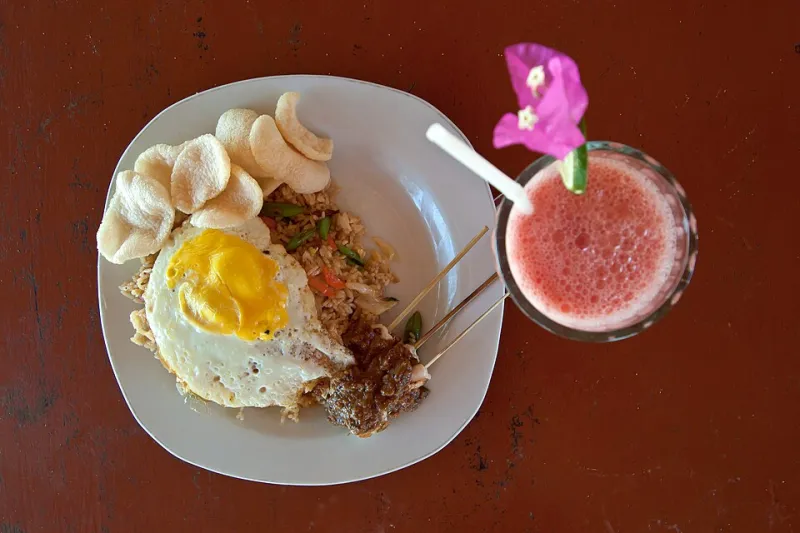
Photo: Vyacheslav Argenberg, CC BY 4.0, via Wikimedia Commons
At about seven in the morning in Ubud, the streets already smell like shallots hitting hot oil. Warungs are open, the coffee is out, and someone is stirring a wok full of yesterday's rice with whatever else survived the night — a little chicken, some greens, an egg cracked over the top. People sit. They eat. Then they get on with the day.
Meanwhile, in an American suburb at the same hour, a parent is handing a frosted pastry through a car window.
I don't say that as a scold. I've been the one handing over the pastry. But somewhere between the 1950s cereal boom and the drive-thru era, we quietly decided that breakfast should be sweet, shelf-stable, individually packaged, and — ideally — consumed at speed, one-handed. And we've been paying for that decision in crashes, waste, and a strange, low-grade loneliness around the first meal of the day.
The Morning Crash Is Not a Mystery
Look honestly at what a standard American breakfast delivers: refined flour, added sugar, and very little else. A frosted toaster pastry might pack 15 to 20 grams of sugar with almost no protein or fiber to slow it down. That's a blood sugar spike followed by a predictable, bone-tired slump somewhere around 10:30 a.m., which we then address with a second coffee and a snack bar that is, functionally, a candy bar with a fiber claim on the wrapper.
A plate of fried rice looks nothing like that nutritionally. Rice, yes, but with egg, vegetables, and a modest amount of protein, plus fat to slow the whole thing down. It eats like a meal rather than a sugar delivery system, and the difference in how the next three hours feel is not subtle.
Leftover Rice Is the Entire Trick
Here's the part that makes this practical instead of aspirational. Nasi goreng — the fried rice Balinese families eat at all hours, breakfast very much included — exists because cold, day-old rice is the ideal raw material. Fresh rice is too wet to fry; leftover rice, dried out in the fridge overnight, sears instead of steams.
Which means the meal is built on food you were probably going to throw away. The USDA pegs American food waste at roughly a third of the food supply, and cooked rice, leftover proteins, and languishing vegetables are right there in the middle of it. A savory breakfast tradition that runs on last night's dinner is, almost accidentally, a waste-reduction strategy.
Five Minutes, One Pan
I'm not going to pretend this requires a recipe, because it doesn't. Hot pan, a little oil, aromatics if you have them — garlic, scallion, a chopped shallot. Cold rice in, pressed flat and left alone for a minute so it actually browns. Whatever protein is in the fridge. Whatever vegetable is closest to the edge. Push it to one side, scramble an egg in the gap, fold it all together, hit it with salt and something acidic — soy, lime, a splash of vinegar.
Total equipment: one pan, one spatula, one burner. No appliance purchase required. No meal-prep Sunday. If you can make a grilled cheese, you can make this on a Wednesday.
The Part That Isn't About Food
But the nutrients aren't really the headline of the Balinese morning. The headline is that people sit down together. Not for long, not for anything ceremonial — just long enough to eat off a plate with another human nearby, or with the person running the warung, who has known them for a decade.
American breakfast, by design, is the most mobile and least social meal of our day. It happens in cars, on trains, at desks, standing over a sink. We've optimized it for time and stripped out the thing that makes a meal a meal. And we have a well-documented loneliness problem that a shared table, even a small one, is one of the cheapest known interventions for.
The Balinese model doesn't demand a lifestyle overhaul. It demands twenty minutes and a willingness to sit.
Try It for a Week and See
Nobody's asking you to abandon pancakes. But try this: for five weekday mornings, eat something savory, built on whatever's left over, and eat it at a table. Not in a car, not at a keyboard. If you live with people, eat it with them, even for eight minutes. If you don't, eat it near a window and put the phone down.
Two things tend to happen. You stop being hungry at ten. And the morning stops feeling like something to survive and starts feeling like the beginning of a day you're actually in.
That's not a wellness hack. It's just breakfast.