Twenty Cents of Coconut and Rice Flour: The Case Against the Wellness Snack Aisle
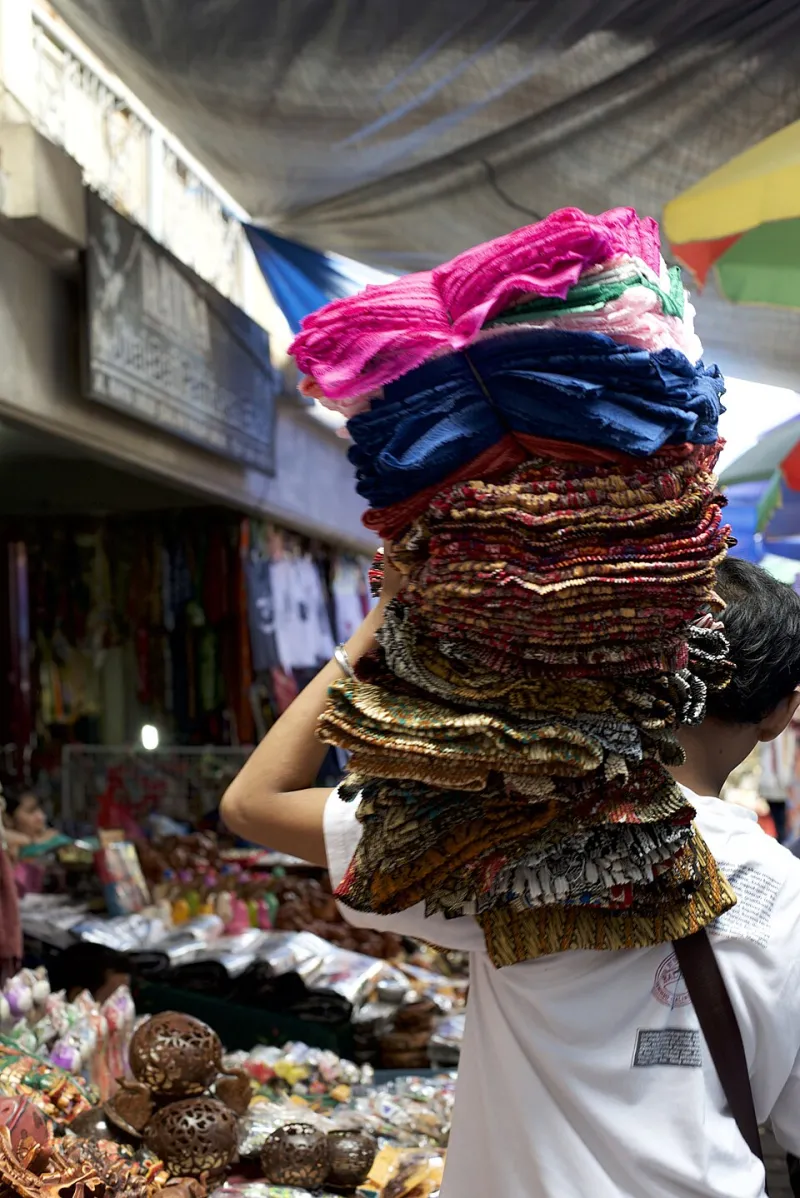
Photo: Mark Chaves, CC BY 3.0, via Wikimedia Commons
Nine in the morning at a Balinese pasar, and the jaje stalls are already doing business. Small banana-leaf parcels, slippery rice-flour balls rolled in coconut, green pandan pancakes folded around palm sugar, little custard cups steamed in tiny cups. Each one costs the equivalent of a dime or two. You buy three, you sit on a plastic stool with a glass of thick Balinese coffee, and you talk to whoever's next to you for a few minutes before going back to work.
Now compare that to the American equivalent: a four-dollar protein bar, printed with a gram count and a fiber percentage, eaten standing up in a break room or at a keyboard, alone.
The bar has better packaging. The jaje wins basically everything else.
First, What Jaje Actually Are
Jaje is the Balinese word for cakes and sweets — a category, not a single thing. The most common are built from rice flour, glutinous rice, grated coconut, palm sugar, pandan, and sometimes cassava or mung bean. They're small by design, usually two or three bites. They're made fresh daily, often by the same households that have sold at the same market for generations, and they're rarely sweet by American standards — the palm sugar has a darker, more molasses-like edge than the sugar we're used to.
A few worth knowing:
Klepon — glutinous rice-flour balls filled with palm sugar, boiled, then rolled in fresh grated coconut. They burst when you bite them.
Dadar gulung — thin pandan-green crepes rolled around a coconut and palm sugar filling. The color is from the leaf, not a dye.
Laklak — small steamed cakes poured into little molds, crisp at the edges, soft in the middle, topped with coconut.
Pisang rai — banana rolled in batter, fried, served hot.
Jaje uli — sticky and savory-sweet, made from glutinous rice and often pressed into shapes for ceremonies.
None of them have a nutrition label. None of them need one.
Now Read the Back of a Protein Bar
I've got one in front of me — a popular national brand, chocolate-chip flavored. Whey protein isolate, soluble corn fiber, erythritol, palm kernel oil, natural flavors, soy lecithin, sucralose, and about eleven grams of sugar alcohol. Twenty grams of protein. Five dollars at the register near the register at the pharmacy.
Here's what's actually in that transaction: a product engineered to deliver a nutrient number while being eaten as fast as possible, in isolation, without pleasure, so you can get to your next task. The bar is not a snack in any cultural sense. It's a supplement wearing a candy costume.
Five Comparisons, One Winner
1. Price per unit of satisfaction. Four dollars for a bar you barely taste versus twenty to sixty cents for two or three jaje that are as much about texture as flavor — the burst of liquid palm sugar, the cool coconut, the chewy edge. The cheaper option is the more memorable one.
2. Freshness as a built-in limit. Jaje are made and sold the same day. They go stale by evening, which means the market has a natural rhythm — you don't stockpile them, you buy what you'll eat. A protein bar has a shelf life of a year. That's not a feature. That's a sign nobody's in a hurry to eat it.
3. Ingredient count. Five to seven recognizable things in most jaje, several of which grew nearby. A typical bar runs fifteen to thirty.
4. The eating speed. Things wrapped in banana leaf and dipped in coffee take time. That's the point. A bar is designed to disappear in ninety seconds.
5. What you're actually buying. With jaje you're paying a neighbor for labor and craft. With the bar you're paying for a manufacturing run, a focus group, and a claim on the front of the box.
The Real Difference Is the Stool You Sit On
If you strip everything else away, the most important difference between a Balinese mid-morning snack and an American one is social. The jaje is a pretext to sit down with another person for ten minutes in the middle of a working day. It's a small, structured break with a beginning and an end, and coffee in a glass, and someone to nod at.
The protein bar, by contrast, is engineered for the exact opposite: it lets you eat without stopping. It's a meal that congratulates you for not having one.
We keep trying to solve a loneliness and burnout problem with better nutrition labels. It has not worked. It will not work.
A Template, Not a Copy
I'm not suggesting you can replicate a Balinese market in Omaha. But the template travels: small portions, made fresh, inexpensive, seasonal, eaten sitting down with someone else, mid-morning, as a deliberate pause.
In practice that might look like this. Find the one Asian grocery near you that stocks frozen klepon or fresh rice cakes — many do now, and the freezer aisle is where you'll find banana leaf and pandan paste too. Or make laklak on a weekend; the batter is rice flour, coconut milk, and a little palm sugar, and it steams in twenty minutes. Buy a bag of oranges from a farmers market in January and split one at 10:30 with a coworker instead of eating a bar at your desk.
The snack itself is almost beside the point. What you're rebuilding is the small, cheap, social pause in the middle of the day that most American workplaces have entirely optimized away.
Jaje cost pennies. The pause costs nothing. Everything the bar is selling, the stall is giving away.